ERP for small and mid-sized manufacturers: what it must do and how to choose
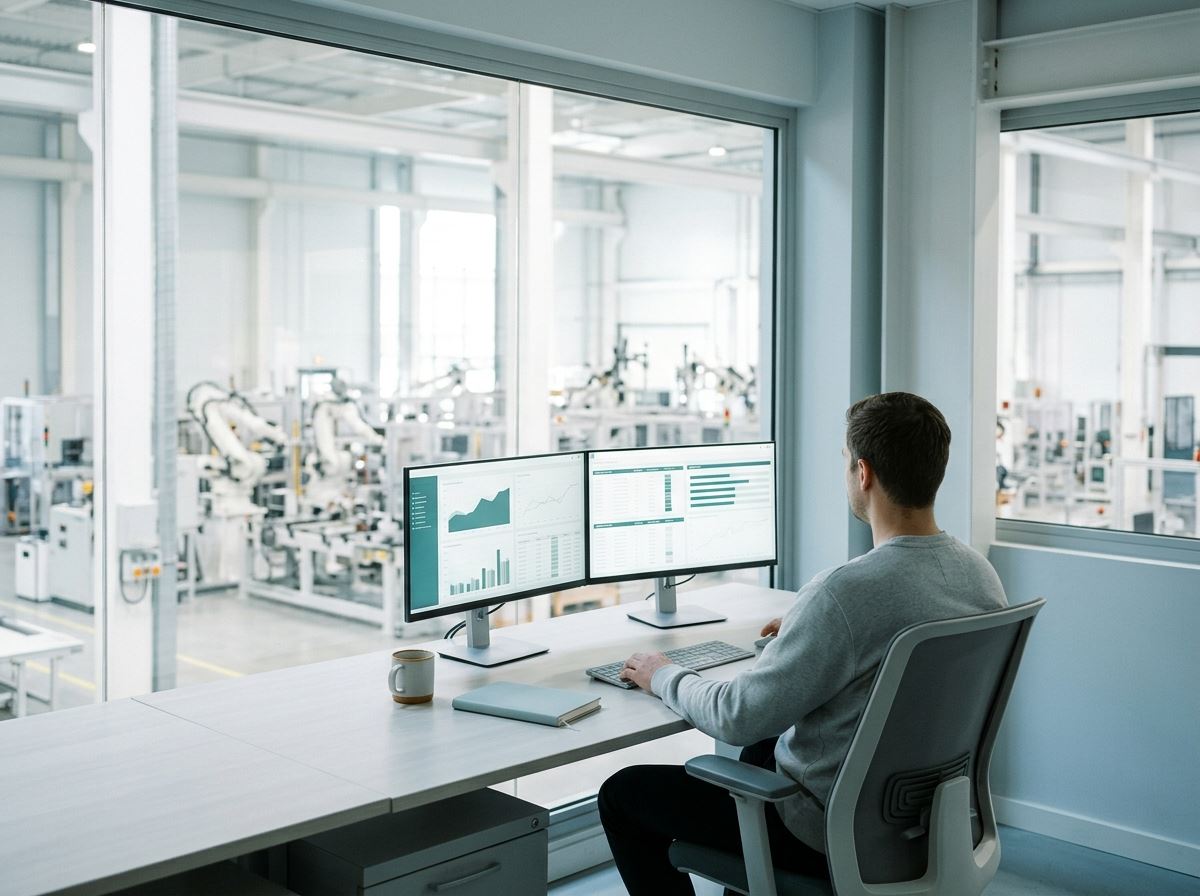
A small manufacturer does not need the same ERP as a global group. It needs a system that follows an order from the first quote to the last invoice, knows what is in stock, tells the workshop what to make next and shows the real cost of each job. Everything else is optional.
At Timeus Lab we build and connect business systems for manufacturers. This guide lists what an ERP for a small or mid-sized factory must do, what it can skip, and how to decide between a standard product and a custom system.
What should a manufacturing ERP cover?
A manufacturing ERP should cover the full path of an order: sales, engineering data, purchasing, stock, production, delivery and money. If any of these lives outside the system, people start copying data by hand and the numbers stop matching.
The core modules are:
- Quotes and orders, with prices built from materials, labour and machine time;
- Bills of materials and routings, which describe what a product is made of and which operations it needs;
- Purchasing and stock, with reorder points and reserved material per order;
- Production planning, which turns orders into work for machines and people;
- Shop floor reporting, where the workshop records start, finish, scrap and hours;
- Quality, with inspections, non-conformities and traceability by batch;
- Delivery and installation, if the company also mounts what it makes;
- Costing and invoicing, comparing planned and actual cost per job.
Make to stock or make to order: why does it matter?
The production model decides which ERP features matter most. A company that makes to stock needs good forecasting and stock control. A company that makes to order, like most window, furniture or machine builders, needs fast and accurate quoting, configurable products and planning that changes every day.
Many ERP products are built around one model and handle the other badly. Before comparing vendors, write down which model you follow and how often a product is unique.
Which features can a small manufacturer skip?
A small manufacturer can usually skip multi-company consolidation, complex transfer pricing, advanced treasury and heavy workflow engines. These features add screens, training and licence cost without solving the daily problems of a single plant.
What should not be skipped is the link to the workshop. An ERP that only the office uses will show planned data, not real data.
How do you connect the ERP to the shop floor?
The ERP is connected to the shop floor in two ways: people report through simple screens at the workstation, and machines report automatically through their controllers. The second needs a data layer that reads PLCs and sensors and turns signals into events such as "order 1042 started on press 3".
Start with manual reporting on tablets or terminals, then automate the machines that matter most. Even partial automation removes most errors in hours and quantities.
Standard ERP or custom system?
| If your company | Usually better |
|---|---|
| Makes standard products in a standard way | A standard ERP with light configuration |
| Has unique quoting or configurable products | Custom quoting connected to a standard or custom core |
| Runs several tools that do not talk to each other | A custom layer that joins them, or a new core |
| Changes its process often | A custom system that the team can extend |
Velton, a window maker in Spain, chose a custom CRM-ERP because its quoting and installation process did not fit standard products. The Velton case shows how the modules were connected.
How do you choose an ERP without regrets?
Choose an ERP by testing it on your own orders, not on a vendor demo. Take three real jobs, one simple, one typical and one difficult, and ask each option to show them from quote to invoice. Watch how many workarounds are needed.
Also check who owns the data, how easy it is to export, and what each change will cost after launch.
Questions
How long does an ERP rollout take in a small factory?
A first set of modules can be in use within a few months. A full rollout is usually done in stages over a longer period, so the factory keeps working throughout.
Can we keep our accounting software?
Yes. Many manufacturers keep their accounting package and connect it to the ERP, so invoices and payments flow automatically.
Do we need barcode or RFID on the shop floor?
Not at the start. Barcodes on job cards and materials make reporting faster and more accurate, and they are cheap to add once the basic process works.
Can Timeus Lab work with our existing ERP?
Yes. We often extend or connect existing systems instead of replacing them, and we only propose a new system when the current one blocks the process.