Building an AI server room: power, cooling and GPU servers
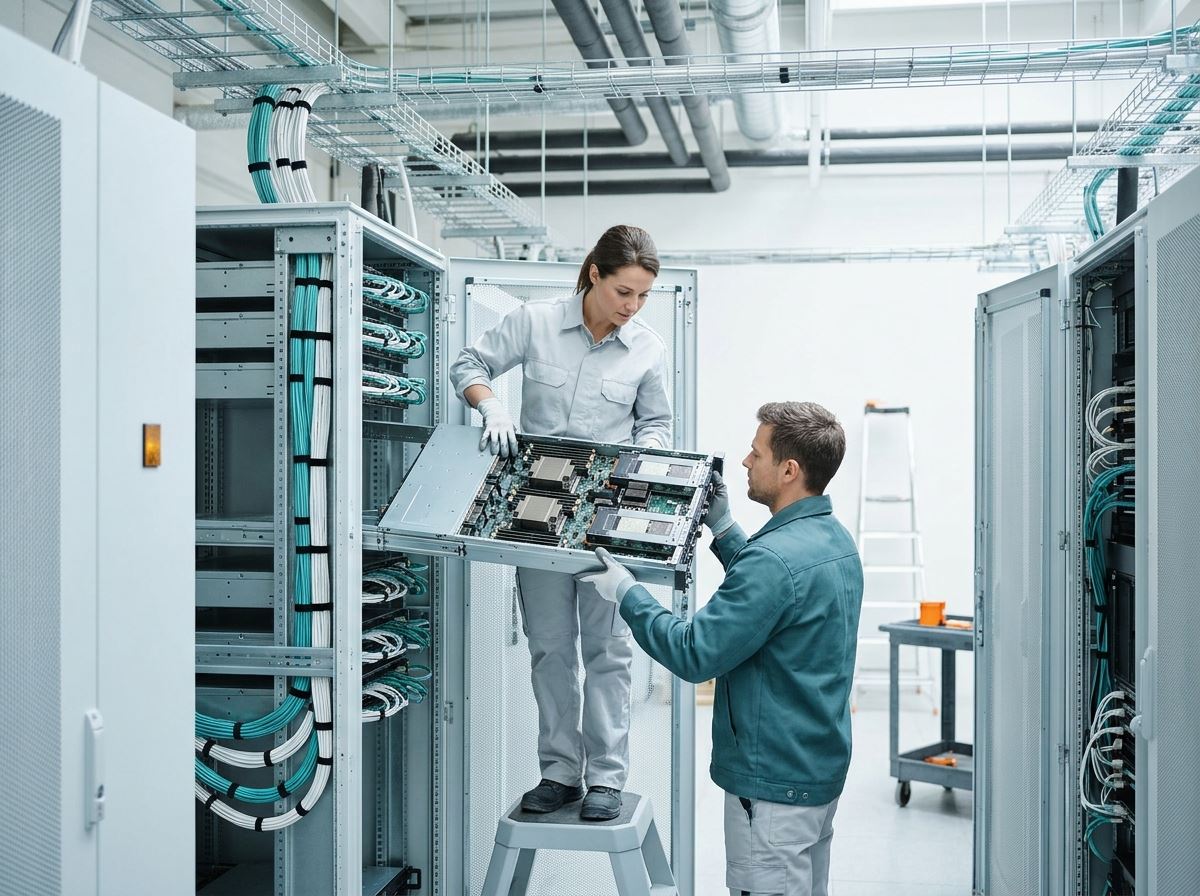
A GPU server is not just a larger computer. A single eight-GPU training server can draw as much power as several ordinary racks together, and almost all of that power turns into heat in a small space. That is why companies that decide to run AI on their own hardware often find that the server is the easy part, and the room around it is the real project.
At Timeus Lab we build server rooms for AI workloads, with the power and cooling they need, and supply the GPU servers that go in them. This article walks through what has to be planned and in which order.
What is AI infrastructure?
AI infrastructure is the hardware and facilities needed to train and run AI models: GPU servers, storage, networking, and the room that houses them with its power supply, cooling, fire protection and physical security. On top of it sits the software layer: drivers, container platforms, model serving and monitoring.
For most companies the goal is not to train large models from scratch but to run them: self-hosted language models, vision models on production data, or fine-tuning on company documents. That changes the sizing a lot.
Why build your own AI infrastructure instead of using the cloud?
Companies build their own AI infrastructure when data must stay on site, when the load is steady enough that owned hardware costs less than renting, or when response time matters for production. Cloud GPUs are ideal for experiments and peaks. For a constant workload running all year, owned or colocated hardware usually becomes cheaper after a period that depends on prices and utilisation, and it removes the question of where confidential data goes.
A common path is to experiment in the cloud, measure the real load, and then size the on-premise system from those measurements instead of from guesses.
How do you choose GPU servers?
You choose GPU servers by working back from the models you will run, the number of users or requests, and whether you will train or only run inference. The main factors are:
- GPU memory. The model weights, plus the working memory for requests, must fit. This is usually the deciding number.
- Interconnect. Large models split across several GPUs need fast links between them inside the server, and fast networking between servers.
- Form factor and power. Data centre GPUs in dense servers deliver the most per rack but need serious power and cooling. Workstation-class cards are cheaper and quieter but limit model size.
- Support and lead times. Popular GPUs can have long delivery times. We plan procurement early.
As a rough guide, small and medium models for document search and assistants can run on one server with a few GPUs. The largest open models need a full eight-GPU server or more.
How much power does an AI rack need?
An AI rack needs several times more power than a traditional server rack. Ordinary enterprise racks are often designed for roughly 5 to 10 kW. One eight-GPU server can draw on the order of 10 kW by itself, so a rack with a few of them reaches 30 to 40 kW or more, and the newest rack-scale GPU systems go far beyond that.
Planning the power supply covers:
- available capacity from the building connection, and whether it must be upgraded;
- distribution to the room and to each rack, with redundant feeds for critical systems;
- UPS sized for a safe shutdown or for ride-through until a generator starts;
- metering per rack, so you know what the AI workload really costs.
Air or liquid cooling?
Air cooling works for moderate densities, and liquid cooling becomes necessary as rack power grows. Every watt a GPU uses becomes heat that has to be removed.
| Approach | Typical range | Notes |
|---|---|---|
| Room air cooling | Low density racks | Simplest, limited by airflow |
| Hot or cold aisle containment | Up to medium density | Separates hot and cold air, big efficiency gain for little cost |
| In-row coolers and rear door heat exchangers | Medium to high density | Cooling placed next to the racks |
| Direct liquid cooling to the chip | High density GPU racks | Coolant plates on GPUs and CPUs, needs a coolant distribution unit and water loop |
The right choice depends on the planned density today and in three to five years. Building for air and adding liquid later is possible if pipe routes, floor loading and space for the coolant units are reserved from the start.
What about networking and storage?
Networking and storage must keep the GPUs busy. A cluster that waits for data wastes the most expensive part of the investment. For inference on one or two servers, standard high-speed Ethernet is often enough. For training across several servers, a dedicated low-latency fabric between GPU nodes becomes important.
Storage needs fast local drives for models and working data, and a shared layer for datasets, document collections and backups. For company knowledge used by language models, the storage also holds the search index and the memory that the model reads from.
In what order is an AI server room built?
An AI server room is built from the outside in, so that nothing installed later forces rework on what came before. The usual order:
- Workload and growth plan: which models, how many users, what density in three years.
- Site survey: space, floor loading, power connection, routes for cooling and cabling.
- Design of power, cooling, fire suppression, access control and monitoring.
- Construction and installation of the room systems.
- Delivery, racking and cabling of servers, storage and network.
- Software stack: operating system, drivers, containers, model serving, monitoring.
- Load testing at full power, then handover and training for your IT team.
Questions
Can you use an existing server room?
Sometimes. Many existing rooms can host one or two GPU servers after upgrades to power distribution and cooling. A survey shows quickly whether an upgrade or a new room makes more sense.
Do you supply the GPU servers?
Yes. We select, procure, install and configure GPU servers, storage and network equipment, and we can also work with hardware you already own.
Can we start small and grow?
Yes, and we recommend it. The room is designed for the target density, but servers are added as real load grows.
Who is Timeus Lab?
Timeus Lab S.L. is an engineering company headquartered in Spain, founded in 2020. About 30 specialists and a network of trusted contractors build infrastructure and software for clients in any country.